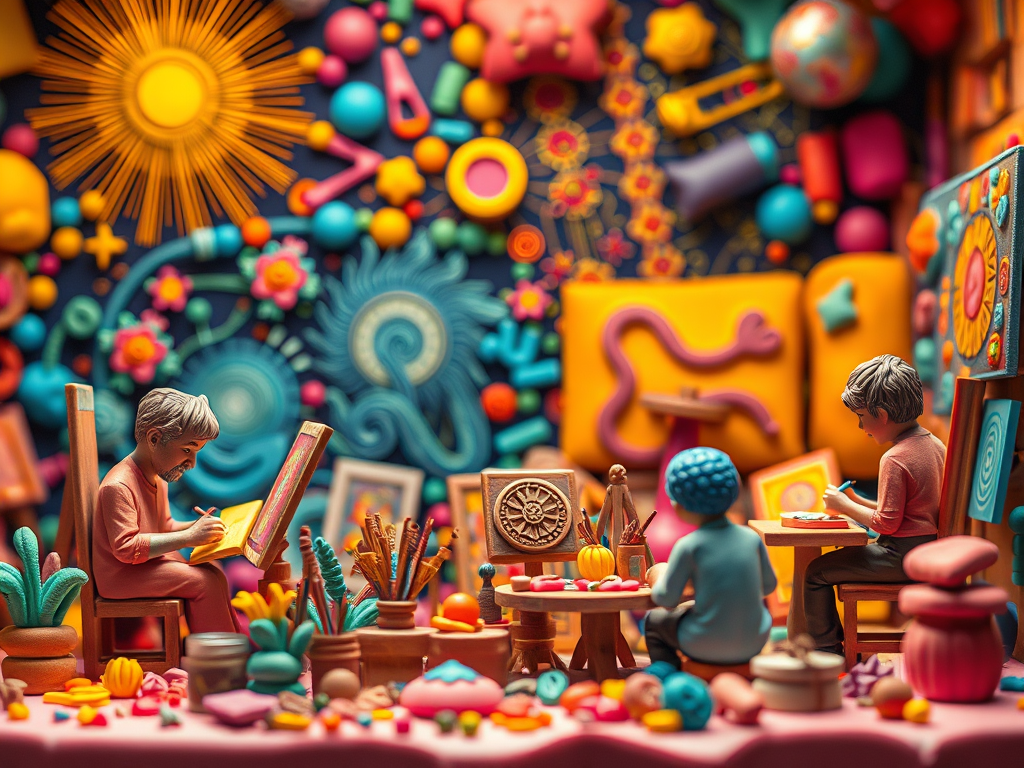
Art is a visual object or experience consciously created through skill and imagination. Artists have always played a vital role in shaping a better world—by inspiring change, sparking conversations, and reflecting society’s hopes and struggles. Through paintings, music, films, or literature, they challenge norms, raise awareness of social and environmental issues, and offer new perspectives that drive progress. Art has the power to heal, unite communities, and ignite emotions that words alone cannot. From protest murals to uplifting music, artists create movements, preserve cultures, and remind us of our shared humanity, making the world more inclusive, expressive, and compassionate.
The AI Revolution and Its Impact on Creativity
With the rapid rise of AI, the world began to fear its impact on creativity. Among all fields, one of the most significant disruptions has been in art. The Writers Guild of America strike against AI in film and media was a clear reflection of this concern.
When I first saw AI-generated artwork with mind-blowing visuals, my initial reaction was: Isn’t this stealing from artists worldwide? The activist in me took over, and I shared an Instagram post highlighting the copyright violations and ethical concerns of repurposing someone’s work without their consent. But soon, curiosity replaced skepticism. I experimented with AI tools like Midjourney, feeding in prompts and watching them transform into breathtaking visuals. The results were astonishing.
AI is here to stay, and denying its presence is futile. But here’s what I realized: not all AI-generated art is compelling. The best AI art isn’t accidental—it stems from creative, well-thought-out inputs. In other words, it still requires a human brain behind it.
AI vs. Human Creativity
To simplify, let’s compare AI’s creative process to a human’s:
- Input & Inspiration: AI takes a prompt, compares it to the massive dataset it has been trained on (books, images, internet data), and selects relevant elements. Similarly, an artist begins with an idea and seeks inspiration from experiences, emotions, and past works.
- Processing & Composition: AI mixes and matches data to generate an image. Likewise, a writer or painter processes their influences, stitches them together, and creates something new in their unique style.
At first glance, AI seems to have an advantage due to its vast training data. But here’s the catch: human inspiration isn’t just based on memory—it’s deeply emotional.
A song, no matter how technically perfect, can be disturbing for one person and profoundly moving for another. AI can analyze patterns but lacks the unpredictability and depth of human experiences. AI can certainly replicate a child’s drawing of an elephant, but can it capture the whimsical chaos of an elephant drawn by a five-year-old living in an Indian countryside? Or the quirky abstraction of one drawn by a kid named X Æ A-12 in Texas? Think about it!
The Decline of Authentic Creativity in Popular Media
Ironically, while AI struggles to replace human creativity, some industries are already operating like AI.
Take the mainstream film industry, for example. Many studios rely heavily on past successful formulas, recycling tropes instead of embracing originality. Even with AI-assisted scriptwriting, these films fail to connect with audiences because they lack emotional depth. It’s no surprise that many Netflix specials feel repetitive—because they prioritize algorithms over genuine storytelling.
What evolves faster than AI? Human experiences, emotions, and taste.
Why Artists Are Irreplaceable
AI can revolutionize industries, lead to automation, and cause job shifts, but it cannot replace human creativity. The key to staying ahead isn’t resisting AI—it’s embracing change while staying true to authentic expression.
So, to all artists: ignore the noise, keep creating, and express your anger, joy, madness, and resistance. Your voice is irreplaceable, and the waves you create will always be more powerful than any algorithm designed for profit.
The world needs more artists—now more than ever.
 On waking up a giant
Leave a comment